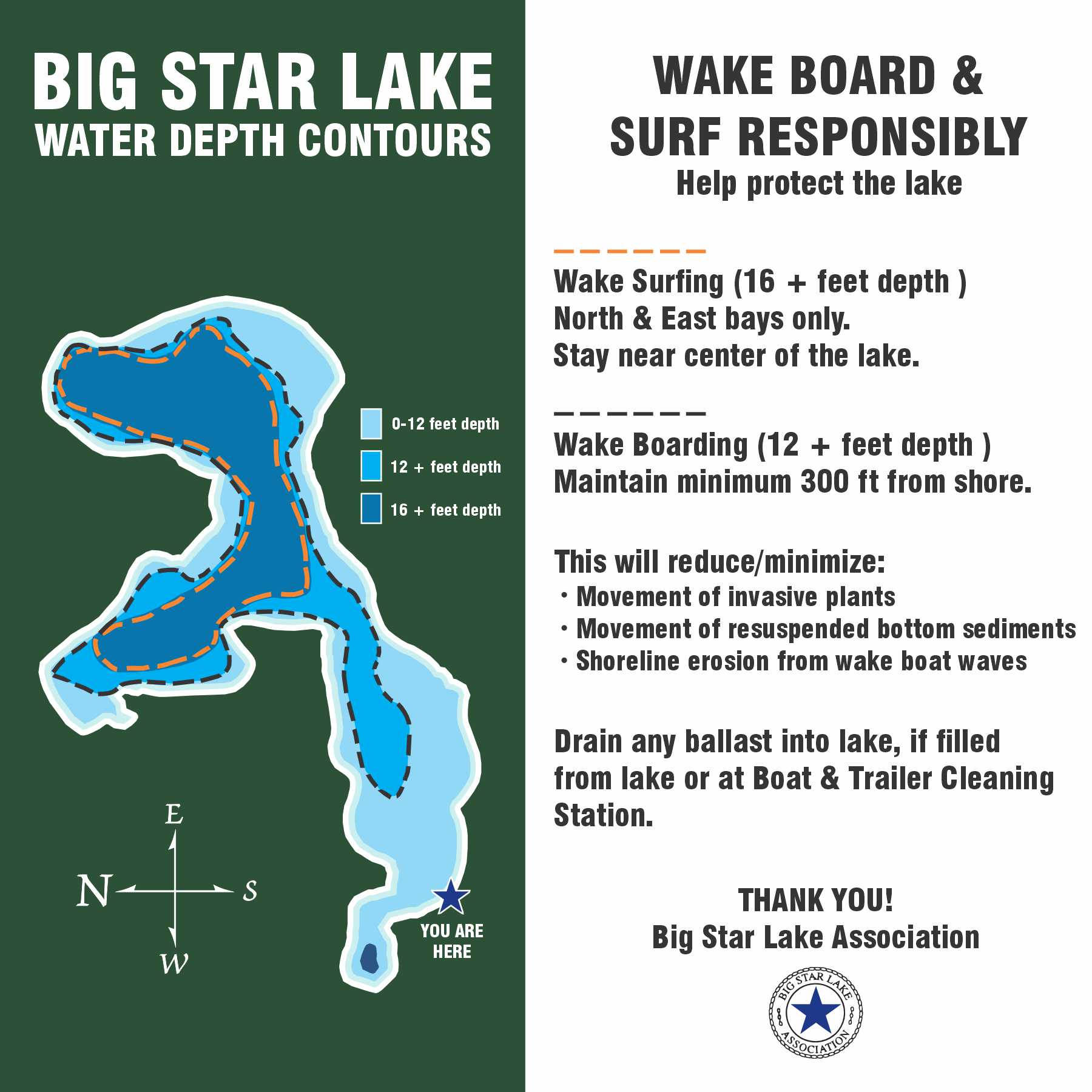
Wake Surfing Information and Recommendations
The Mission of the Big Star Lake Association (BSLA) is to protect and preserve the natural beauty and environmental health of Big Star Lake and its surrounding areas.
Over the past several years, there has been a significant increase in the popularity of wake surfing. Wake surfing is significantly different from skiing, tubing or other types of boating.
Below are links to various research projects on wake surfing and the impact it has on inland lakes and their aquatic habitats.
Recreational Powerboat Hydrodynamics and their Impacts on the Water Column and Lakebed
In July of 2025, the University of Minnesota (UMN), St. Anthony Falls Laboratory, published a Field Study of Recreational Powerboat Hydrodynamics and their Impacts on the Water Column and Lakebed.
Click below to view the report:
Wake Boat Effects on Aquatic Habitat
In July of 2023, the Michigan Department of Natural Resources (DNR) published a Literature Review of Wake Boat Effects on Aquatic Habitat, and has offered recommendations including best practices for operating wake boats while minimizing the effects of these powerful waves.
The BSLA supports and encourages all boaters to adopt these best practices in order to help protect and preserve the health and water quality of Big Star Lake.
Click below to view the report:
Report Highlights: Wake Boat Effects on Aquatic Habitat
The operation of wake boats in a manner that creates large waves can erode shorelines and resuspend
sediments, and is an emerging threat to natural resources in inland lakes. Wake boats can produce
waves with 1.7–17 times the energy of other comparable-sized powerboats and their propellers
generated enough turbulence to resuspend bottom sediments in water up to 33 feet deep. The large waves generated by wake boats take between 400–1,023 feet to dissipate to heights and wave energies
observed 100–200 feet away from typical boats operating at cruising speed.
Michigan’s current boating laws and regulations are intended to both promote public safety and
avoid property damage but were created prior to the commercialization and popularization of wake
boats in the early 2000s. As a result of the large waves and increased scour caused by these vessels, the existing 100-foot operating buffers around docks and shorelines on inland lakes are not sufficient to
protect aquatic resources.
The Michigan Department of Natural Resources, Fisheries Division recognizes the recreational value and popularity of wake boats, and recommends the following voluntary best operating practices in support of the continued use of wake boats while minimizing the effects on natural resources:
1. Boats operating in wake-surfing mode or wake-boarding mode, during which boat speed, wave
shapers, and/or ballast are used to increase wave height, are recommended to operate at least 500
feet from docks or the shoreline, regardless of water depth.
2. Boats operating in wake-surfing or wake-boarding modes are recommended to operate in water
at least 15 feet deep.
3. Ballast tanks should be completely drained prior to transporting the watercraft over land. It is recommended that awareness and voluntary adoption of these best operating practices be encouraged through outreach actions and materials to educate wake boat operators.